Red Sea vs Caribbean
vs Maldives —
Is the Red Sea Worth It?
The honest comparison every luxury traveler should read before booking their next underwater adventure.
Yes. And it’s not particularly close.
We’ll be direct: for most luxury travelers — whether you dive, snorkel, or simply want extraordinary water in a setting that rewards curiosity — the Red Sea outperforms the Caribbean and rivals the Maldives in almost every measurable category, at a fraction of the Maldives’ cost.
That’s not a sales pitch. It’s what divers and marine biologists consistently say when the data is laid out honestly. The Red Sea is home to over 1,200 species of marine life, 300+ species of coral, and some of the healthiest reef systems on Earth. Over 10% of all marine species in the Red Sea are endemic — meaning they’re found nowhere else on earth. No other destination on this list can make that claim.
Red Sea average
Red Sea biodiversity
Found nowhere else on earth
But numbers only tell part of the story. What makes the Red Sea genuinely special — and what no chart fully captures — is the combination of what’s underwater, what’s on land, and what it feels like to be there. It is the only diving destination in the world that sits beside one of the greatest civilizations ever built. You can dive a coral wall in the morning and stand in front of a 3,400-year-old temple in the afternoon.
The water is extraordinary.
Here’s why.

The Red Sea’s coral reefs — among the healthiest in the world, with visibility regularly exceeding 30 metres
The Red Sea is semi-enclosed — surrounded by desert on both sides — which gives it two exceptional qualities that open-ocean destinations can’t match: very low rainfall and runoff (meaning almost no silt or sediment), and extremely high salinity. The result is visibility that consistently reaches 30 metres and often exceeds 40 metres at the best sites. Dropping over the edge into 150 feet of visibility in the Red Sea can be 50 feet more than what you’re accustomed to in the Caribbean.
The marine life is dense and diverse in a way that surprises even experienced divers. The Red Sea offers more shark action than the Maldives and is home to around 1,000 different species of fish feeding off its extensive coral reefs. You’ll find oceanic whitetips, hammerheads, thresher sharks, and whale sharks — alongside schooling barracuda, vast clouds of anthias, moray eels, dolphins, dugongs, and turtles. The colors and marine life of the Red Sea are simply nowhere near what you’d see in the Caribbean, even on a bad day.
The wrecks are a chapter of their own. The SS Thistlegorm — a British WWII supply ship sunk by German bombers in 1941 — is widely considered the greatest wreck dive on earth. Its cargo of wartime relics makes it an underwater museum like no other. The Maldives and Caribbean simply have nothing comparable.
Red Sea vs Caribbean
vs Maldives — side by side.
Every destination has genuine strengths. Here’s where each one wins — and where each falls short.
| Category | Red Sea | Caribbean | Maldives |
|---|---|---|---|
| Visibility | 30–40m typical | 15–25m | 20–30m |
| Coral health | Among the world’s best | Significantly degraded | Excellent |
| Marine diversity | 1,200+ species, 10% endemic | 600–700 species | ~1,000 species |
| Shark encounters | Oceanic whites, hammerheads, whale sharks | Nurse sharks, limited variety | Reef sharks, whale sharks (seasonal) |
| Historic wrecks | Best in the world (Thistlegorm) | Some, mostly small | Limited |
| Year-round diving | Yes — all 12 months | Yes, hurricane season June–Nov | Yes, but monsoon affects visibility |
| Land experiences | Ancient Egypt, grand hotels, culture | Good beaches, islands | Overwater villas, remote |
| Luxury cost | Excellent value vs quality | Moderate | Highest cost globally |
| Flight from US East Coast | ~12 hrs (Cairo/Hurghada) | ~4–5 hrs | ~20+ hrs |
The Caribbean’s one clear advantage is proximity from the US. If you have three days and need an easy escape, the Caribbean wins that argument. For a serious trip — a week or more — the Red Sea is in a different category entirely.
The Maldives is a genuinely beautiful destination, and for travelers who prioritize overwater villa aesthetics and a certain kind of barefoot luxury above everything else, it delivers. But the coral in the Maldives is generally better in the Red Sea, and the dive sites are as interesting — at significantly lower cost. The Maldives is also increasingly expensive and increasingly crowded at its most famous resorts. The Red Sea’s best sites remain far less visited.
Most people do the Red Sea wrong.
Here’s the right way.
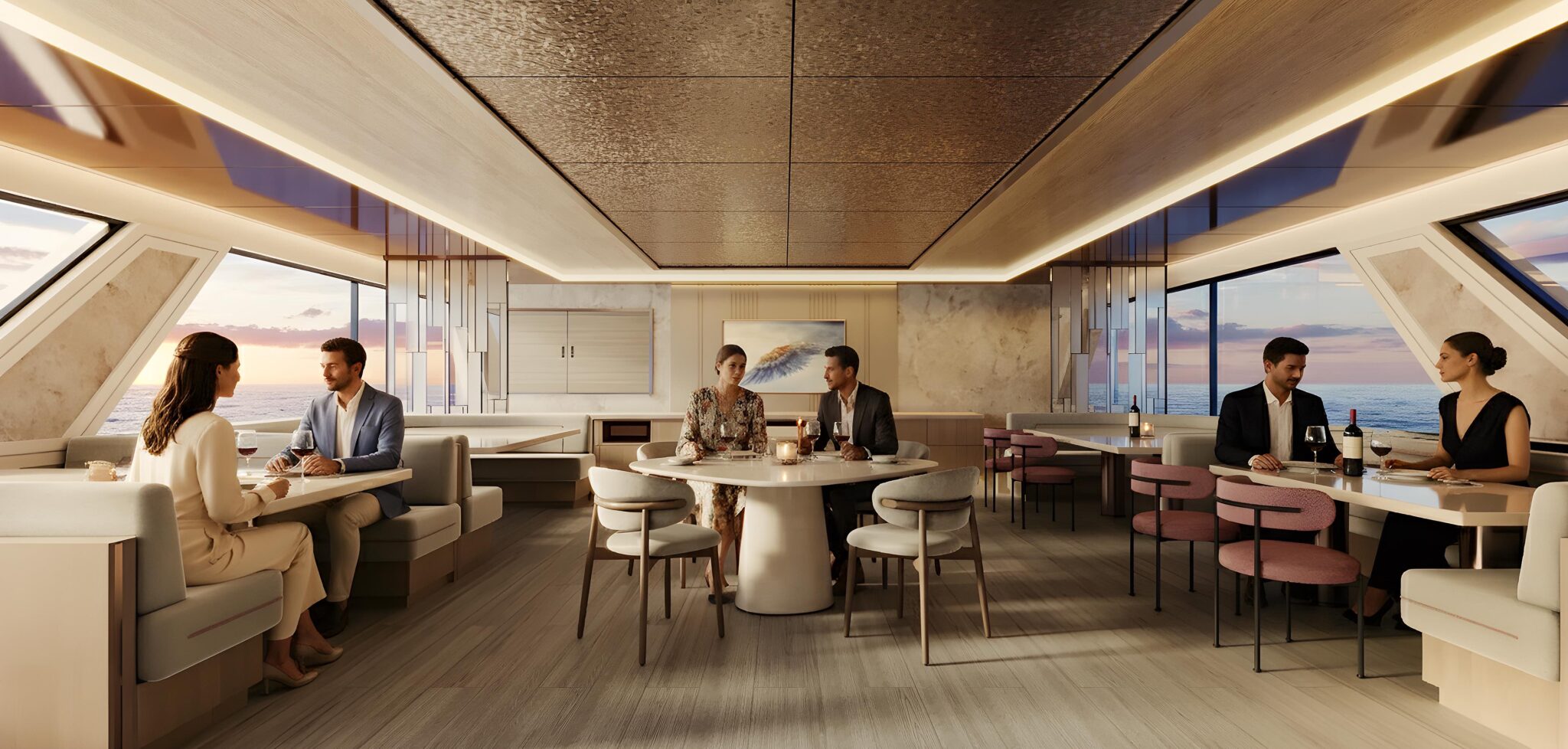
The Red Sea from a private vessel — an entirely different experience from shore-based resort diving
The most common complaint about the Red Sea — the one you’ll find on diving forums and TripAdvisor — is that the popular sites near Hurghada and Sharm El-Sheikh get crowded with day boats. Twenty divers on a site designed for eight. That’s a real problem, and it explains why some people come back underwhelmed.
The solution is simple: get on a liveaboard, or better still, a private vessel with a small group and an itinerary built around the sites that day boats can’t easily reach. The remote south — Big Brother, Little Brother, Daedalus Reef, Elphinstone — is where the Red Sea truly opens up. These are the sites where you encounter oceanic whitetips in open water, where hammerheads circle in the blue, where the reef walls drop to 60 metres without a single other diver in sight.
Boreas is Egypt’s first true floating resort on the Red Sea — a 300m² luxury vessel built in 2026 to marine-grade steel, sailing from Hurghada and Port Ghalib on 2–7 day itineraries. It’s not a dive boat with cabins. It’s a resort that happens to float — with a sea pool, full spa, two bars, gourmet Mediterranean dining, a gym with sea views, and a water slide.
Maximum 20 guests. PADI professionals on board. Itineraries that reach the sites day boats don’t. And when you return from a dive, you surface to a sun deck, a cold drink, and 30 metres of visibility still glowing in your memory.
This is what the Red Sea is supposed to feel like.
The Red Sea offers something
no other destination can.

Abu Simbel — two hours from the Red Sea. The Maldives offers overwater villas. Egypt offers this.
Here is what we keep coming back to: the Maldives and the Caribbean are beautiful. But they are, in the end, single-note destinations. You go for the water. You leave with beautiful photographs of turquoise water and coral.
The Red Sea is something else entirely. You can dive a world-class reef in the morning, sail north to Hurghada by afternoon, fly to Luxor the next day and stand inside a temple built 3,400 years ago, take a sunset boat to the Valley of the Kings, sleep at the Winter Palace Hotel where Lord Carnarvon planned the excavation of Tutankhamun’s tomb — and do all of this in a single week.
No other diving destination on earth sits beside that kind of history. That combination — extraordinary water and extraordinary land — is what makes Egypt genuinely unique. The Caribbean can’t offer it. The Maldives can’t offer it. Only Egypt can.

The Nile at Cairo — an hour from the Red Sea. A world away from anything the Caribbean or Maldives can offer.
✦ Water temperature: 22–28°C year-round — no wetsuit required in summer
✦ Visibility: typically 25–40 metres — among the clearest waters on earth
✦ Marine life: 1,200+ species, dolphins, dugongs, hammerheads, whale sharks
✦ Wrecks: the SS Thistlegorm (WWII) — widely considered the world’s best wreck dive
✦ Season: excellent year-round — no hurricane risk, no monsoon disruption
✦ Combined with Egypt land touring: Cairo, Luxor, Aswan, Alexandria — all within easy reach
Ready to experience
the Red Sea properly?
Boreas is Egypt’s only luxury floating resort — 300m², built in 2026, sailing to the sites most vessels never reach. Tell us your dates and we’ll build the right itinerary for you.
Plan your Red Sea journey2–7 day itineraries · Full charter available · US: +1 646 624 8304